Greenlight Industries
Composite Manufacturing Intelligence

"You haven't designed the lightest composite
if you lack the requisite data."

We are designing a machine to give the AI all the tools it needs to make and manufacture the next generation of structures. One coupled process — from the first datasheet to the finished part.

Stage 1

Data

As-made materials properties, keyed to the machine that produced each part. Your proprietary data stays in your namespace.

Stage 2

Design

Upload a target — strength, weight, cost. Greenlight AI selects the optimal layup and validates the design with real physics before a single ply is laid.

Stage 3

Validate & Build

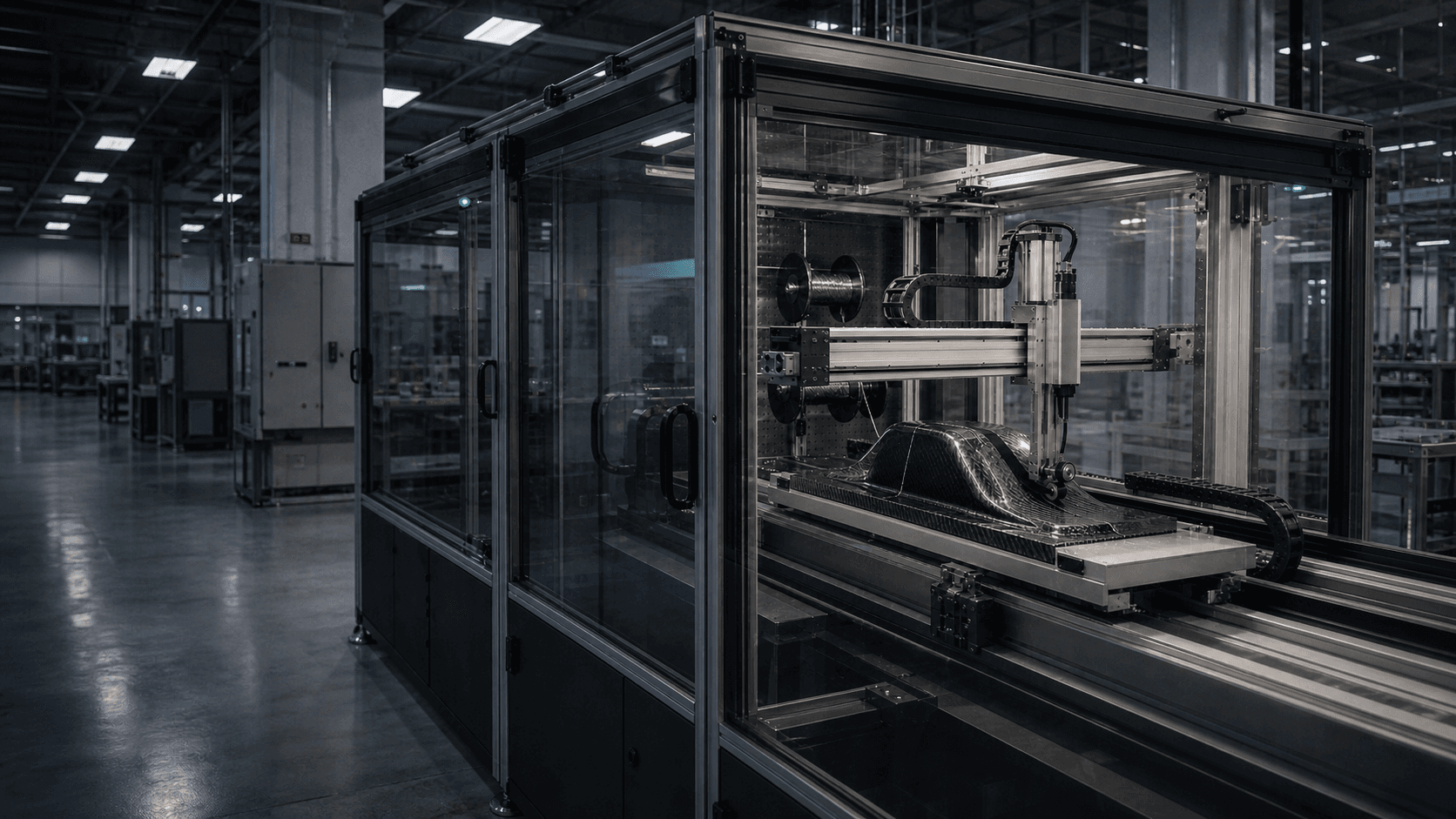
A precision gantry machine — not a 3D printer — executes the validated design in a climate-controlled cell and captures every build parameter as as-made data.

Phase 0 complete·2 NASA-awarded patents·Prototype co-development with Andrews-Cooper·Raising $6M Seed
About Our Company

Building the machine composite manufacturing has been waiting for.

Greenlight Industries is a NASA-spinoff startup with a singular mission: make composite manufacturing as precise, repeatable, and data-rich as a CAD file. Our product — the TapeLayer™ — is the first composite fabrication system to couple material data, AI-driven design, and precision manufacturing into one closed loop.

"We are designing a machine to give the AI all the tools it needs in order to make and manufacture the next generation of structures." — Dr. Robert G. Bryant, Founder & CEO

Our product

The TapeLayer™ is a self-contained, environmentally controlled composite fabrication cell housed in a standard shipping container format. A customer uploads a CAD file and specification; the system selects the optimal layup from real as-made materials data, simulates the build, then executes it with precision workmanship — capturing every parameter as the part is made. The result: a finished engineered composite part with a complete, traceable as-made data record, ready to certify.

This is not a 3D printer. It is a coordinate-axis machine with a sealed environment, material-agnostic head, and the intelligence to improve with every part it builds. The data from one machine is coupled to that specific machine — which is exactly why no competitor can buy, copy, or license what our customers will accumulate.

The team

Dr. Robert G. Bryant
Founder & Chief Executive Officer
30+ years NASA Langley. Branch head. 30+ patents, including 2 on TapeLayer™. National Inventors Hall of Fame · Space Foundation Hall of Fame · NASA Inventors Hall of Fame.
View CV
David Branson Smith
David Branson Smith
Chief Financial Officer & Investor Relations
Capital markets, venture financing, and business development. First contact for investor and partnership inquiries.
LinkedIn
Richard Newton
Richard R. Newton
Co-Founder & General Counsel
Legal structure, IP strategy, and corporate governance for the Greenlight entity.
LinkedIn
Phase 0 complete · $200K self-funded·Delaware C-Corp·HQ: Virginia·Build partner: Andrews-Cooper
State of the Art

How composite manufacturing works today — and what we're changing.

Composite parts are over-engineered because the industry lacks a feedback loop. Material spec sheets describe textbook conditions. Real as-made properties — the actual fiber volume fraction, the real cure cycle variation, the workmanship at Step 1 — are never measured and never linked back to the design. The result: engineers add safety factors on top of safety factors, and customers pay for it in weight, cost, and months of qualification time.

The industry today
Vendor spec sheets
Textbook properties, not as-made
Software design & simulation
Based on idealized models
Factory workmanship
Manual layup, no feedback
With Greenlight
Directly coupled
As-made properties
Real data from the actual machine
Greenlight AI design
Layup optimized on real data
TapeLayer™ workmanship
Precision, controlled, traceable

What changes when the loop closes

1

Right-sized parts

When you know the real as-made properties, you design to them — not to a worst-case spec-sheet floor plus a safety factor. Parts are lighter, cheaper, and meet the actual requirement instead of a manufactured margin.

2

Insurable uncertainty

Calibrated uncertainty bands replace gut-feel overdesign. A part with a known ±10% property distribution is underwritable in a way that an over-built guess never is. Greenlight gives insurers and certifiers something they can actually use.

3

Machine-coupled moat

The data from one TapeLayer™ is tuned to that specific machine's sensors, actuators, and environment. It cannot be transferred to another machine, licensed away, or replicated by a competitor — it compounds in place. The longer a customer runs, the wider the gap.

Sarah's Journey

A composite engineer qualifies a new material. End to end.

Sarah is a structural engineer at a company making composite brackets for an OEM. She needs to qualify a new prepreg — faster than the industry standard 12–24 month requalification cycle, and at a fraction of the cost. This is what the Greenlight process looks like in practice, from the first datasheet to a machine-ready build specification.

"We're not just demonstrating a tool. We're demonstrating a possibility — composite manufacturing that learns from itself."
1

SpecSniper — Sarah uploads the datasheet.

TC1320 PEKK is a new material — it's not yet in the database. She drops the datasheet into SpecSniper. In seconds, every material property is extracted, structured, and sourced. No manual entry, no transcription errors, no guessing at units.

2

Strata — She benchmarks TC1320 against the database.

Strata surfaces every comparable material already in the system. Sarah sees qualification complexity at a glance — TC1320 PEKK requires fewer cycles than the thermoset alternatives she's used before.

3

Optimax — The AI recommends an optimal layup.Simulated

Sarah enters her bracket geometry: 200mm × 60mm cantilever, 75N point load at tip. Optimax applies classical laminate theory across the TC1320 PEKK dataset and returns a recommendation with a 94% confidence score. Geometry input is illustrative — CAD integration is in development.

4

Avatar — She simulates the bracket under load.

Avatar's beam solver deflects the bracket 1.8mm under 75N — well within the 5mm spec. Sarah probes failure by increasing to 200N. The root flushes red. No black zone: no irreversible deformation. The design is safe.

5

TapeLayer™ — The machine builds it. No touch labor.Coming With Hardware

Sarah submits the approved layup spec. The TapeLayer™ reads it directly: temperature, humidity, tape tension, and actuator position — all controlled, all recorded. The part emerges from the sealed environment. Zero human hands on the layup.

6

SpecSniper ← As-Made Data — The build becomes a data point.Coming With Hardware

As-made data from the bracket flows back into the company's own SpecSniper. Not the datasheet values — the actual measured structural properties from this build, this machine, this environment. The company decides whether to keep it private or share it. Either way, their next Optimax run has real data — not just a datasheet estimate.

Sarah's company also uses Optimax to model a cost-reduction scenario: an OEM wants a 30% cost cut. Optimax redesigns the bracket as a hybrid-material part optimized for cost, and flags the option of deploying a TapeLayer™ at the OEM's own facility — where the OEM pays their own electricity and Greenlight earns a remote operating fee. This is Manufacturing-as-a-Service.

Follow Sarah's full journey →
Pitch Deck

The Greenlight story, built to be shared.

The investor and customer pitch materials are available to credentialed investors and partners via the portal. Sign in below, or request access from david@gl-ind.com.

Investor Pitch Deck

Seed round deck: problem, product, team, traction, ask. For credentialed investors.

Customer Overview Deck

Product and process overview for potential customers and partners. Covers the TapeLayer™, the software suite, and the three revenue models.

Access note: Investor materials require portal sign-in. If you haven't received an invite, contact david@gl-ind.com. Customer decks are available to all authorized portal users.
Letter of Interest

Ready to explore a partnership? Start here.

A Letter of Interest (LOI) is our starting point for any serious conversation — a lightweight, non-binding document that opens the door to deeper technical and commercial discussion. Signing an LOI gets you early access to the condensed business plan, priority positioning as we approach Phase 1, and a direct line to Rob and David for technical questions.

This is not a purchase commitment. It is a statement of intent to explore — and the first step toward NDA-gated access to the full Greenlight platform.

What the LOI covers

  • A brief description of your organization's interest area (research, OEM supply chain, MaaS, investment)
  • An acknowledgment that Greenlight's process, data, and AI are coupled to the TapeLayer™ hardware
  • Mutual intent to explore a formal agreement — supply, licensing, co-development, or investment — within a defined window
  • Confidentiality of any shared materials until a formal NDA is in place

How to sign

When you're ready, reach out to David. He will send the LOI template via Google Docs for e-signature — typically same-day. Once signed, you'll receive an invitation to the full partner portal and the condensed business plan.

Email David directly
Try It Live

The tools, live. Four stages of one process.

SpecSniper, Strata, Optimax, and Avatar are all live and running. Portal access is required — sign in below or request an invite from david@gl-ind.com.

Portal access required
The live tools are available to invited partners and investors. Sign in to your portal account, or request an invite.
Sign in to Portal →
Live Demonstrations

Watching a movie vs. being in the movie.

A recorded walkthrough tells you what the system can do. A live demonstration with your materials and your targets shows you what it does for you, in real time. We run live sessions by appointment for credentialed partners.

By appointment, for invited partners
Live demonstrations run with your materials and your targets — not a canned deck. To schedule, sign in to the portal or reach out to david@gl-ind.com.
Business Plan

The full picture — market, model, and roadmap.

The condensed business plan covers our addressable market, three revenue streams, Phase 1 use of funds, and financial projections through 2029. Available to LOI signatories and invited investors.

Available after LOI or investor onboarding
Sign an LOI or receive an investor invitation to access the condensed business plan. Contact david@gl-ind.com to start the process.
Sign in to Portal →